When urban and suburban redevelopment projects demand the removal of older structures, demolition contractors often face a significant environmental and safety hurdle: asbestos. Every year, approximately 44,000 commercial buildings are demolished in the United States. Many of these structures were built prior to 1985 and heavily contain Asbestos-Containing Material (ACM).
The most economical way to clear these sites is through whole-building demolition, a process where heavy equipment (like backhoes and front-end loaders) push the structure down and crush the debris for transport. But what happens when nonfriable asbestos is left in the building during this aggressive process?
A compelling case study evaluated two demolition projects in Fairbanks, Alaska, to determine if leaving certain types of ACM in place during whole-building demolition poses a risk of toxic exposure to workers or the public. The results might surprise you.
[source: https://doi.org/10.1080/15459620701691023 ]
Understanding Asbestos Regulations: EPA vs. OSHA
Before diving into the study, it is crucial to understand the regulatory landscape governing asbestos removal. The EPA’s National Emission Standards for Hazardous Air Pollutants (NESHAP) regulates demolitions involving ACM. NESHAP divides ACM into two categories:
- Friable: Easily crumbled to powder by hand pressure, making it highly likely to release toxic fibers.
- Nonfriable: Bound materials that do not easily release fibers unless subjected to intense mechanical forces.
Generally, all regulated ACM must be removed prior to demolition. However, regulatory definitions can complicate the process. For instance, gypsum wallboard (GWB) often features a joint compound containing asbestos.
- The EPA Approach: The EPA evaluates heterogeneous materials like GWB as a composite. If the combined wallboard and joint compound contain less than 1% asbestos, it is not considered ACM under their rules.
- The OSHA Approach: OSHA, conversely, analyzes each layer separately for worker safety. Therefore, the joint compound alone is often classified as ACM, requiring strict work practices to prevent worker exposure.
According to standard guidelines, Category I nonfriable ACM (like roofing) and Category II nonfriable ACM are generally allowed to stay during demolition unless the process will cause them to crumble and become friable.
🍁 Note for Canadian Readers: This article references U.S. EPA emission standards and OSHA regulations for context. While Canada’s environmental regulations are highly harmonized with the EPA, they are independently governed by Environment and Climate Change Canada (ECCC). Specific emission limits, definitions of ACM, and compliance procedures may differ significantly. Please consult Canadian federal or provincial guidelines for exact local requirements.
The Demolition Case Studies: Building A and Block B
Researchers closely monitored two whole-building demolitions in Fairbanks to evaluate actual airborne asbestos fiber release in real-world conditions.
Building A: A Dangerous Hotel Structure
Building A was a condemned, multi-story concrete block and timber-framed hotel. Because it was at risk of “imminent collapse,” the EPA and the local landfill granted a special exemption allowing the structural ACM to remain in place to protect the demolition crew. The building contained:
- 2,400 m² of GWB with 2–3% chrysotile asbestos in the joint compound.
- 560 m² of Category II flooring (2–3% chrysotile).
- 1,400 m² of “popcorn” ceiling surfacing (5% chrysotile).
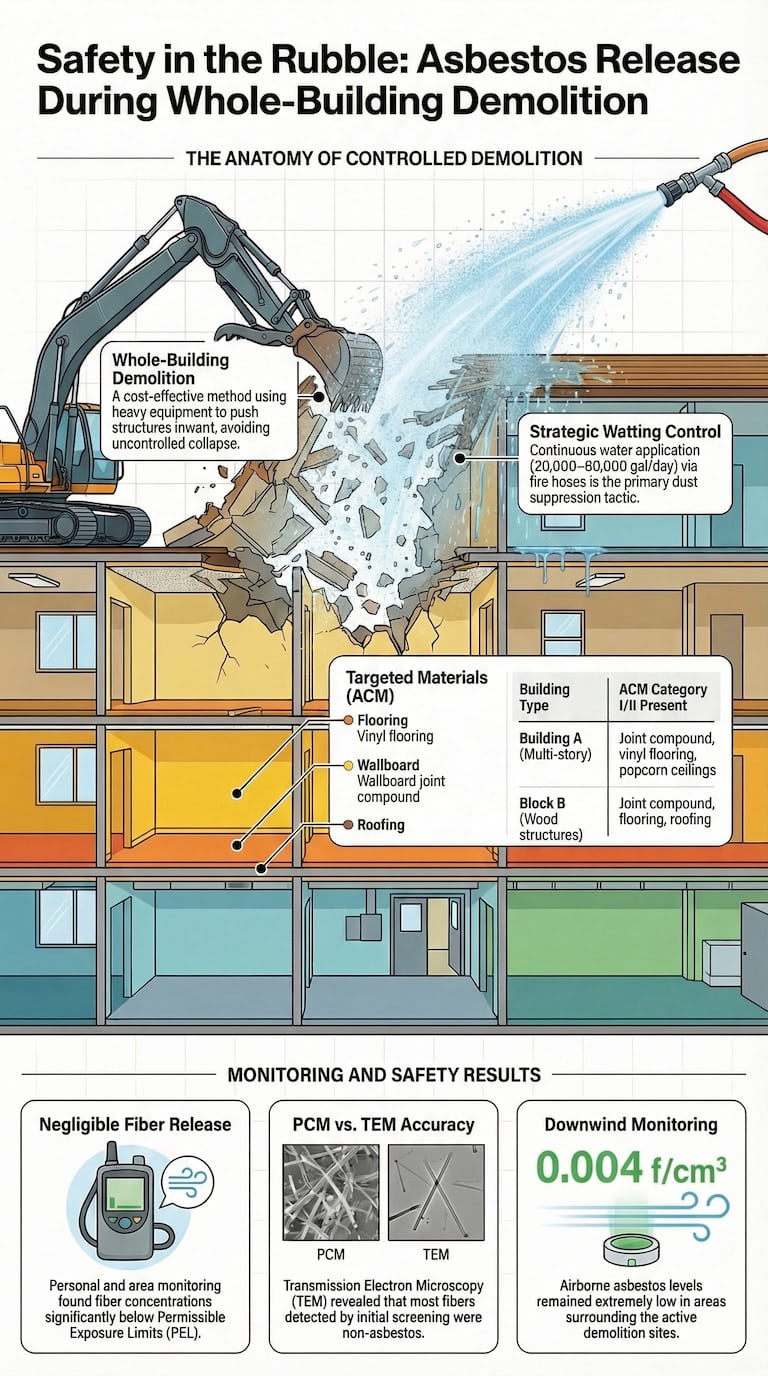
Contractors used a crane with a wrecking ball to reduce the upper stories, followed by excavators to crush and load the remaining debris. Due to structural dangers, the interior could not be pre-wetted. Instead, the fire department heavily soaked the exterior with a boom truck, and fire hoses continuously wetted the debris during loading. This required a massive 20,000 gallons of water per day.
Block B: Wooden Commercial Buildings
Block B consisted of several one- and two-story wooden commercial buildings. They were systematically pushed down by bulldozers and loaded into dump trucks. These structures contained:
- 1,120 m² of GWB with 5–8% chrysotile in the joint compound.
- 1,130 m² of Category I flooring and roofing.
Similar to Building A, the site was continuously doused using fire hoses, utilizing an estimated 64,000 gallons of water per day for optimal dust suppression.
The Results: Does Whole-Building Demolition Cause Toxic Exposure?
To monitor safety, industrial hygienists collected personal breathing zone samples from workers and area samples from downwind locations and adjacent buildings.
Initially, samples were analyzed using Phase Contrast Microscopy (PCM), which counts all airborne fibers but cannot distinguish between asbestos and non-asbestos fibers. PCM results indicated a slight increase in airborne fibers, but concentrations remained well below OSHA’s Permissible Exposure Limits (PEL).
When certain PCM samples approached the excursion limit, researchers utilized Transmission Electron Microscopy (TEM), a highly precise method that specifically identifies and counts actual asbestos structures.
The TEM analysis revealed a critical finding: Most of the fibers detected initially by the PCM method were not asbestos.
- Building A Results: The highest worker exposure recorded by PCM was 0.141 fibers/cm³. However, when analyzed by TEM, the actual asbestos concentration was only 0.013 fibers/cm³, far below dangerous levels. Area monitoring downwind showed asbestos fiber levels at less than 0.004 fibers/cm³.
- Block B Results: Out of nine air samples analyzed by TEM, only two asbestos fibers were found in total.
Key Takeaways for the Demolition Industry
This case study highlights several vital lessons for modern environmental hygiene, safety compliance, and demolition practices:
- Water is the Ultimate Suppressant: The sheer volume of water used (up to 64,000 gallons daily) was critical to suppressing dust and preventing toxic fiber release. Contractors must secure robust water supplies, as standard 3,000-gallon water trucks are entirely insufficient for this scale of continuous wetting.
- Negligible Asbestos Release: Despite the presence of Category I and II nonfriable ACM, as well as GWB with ACM joint compound, whole-building demolition did not result in a significant release of asbestos fibers when properly managed.
- The Importance of TEM Testing: Relying solely on PCM testing during demolitions involving gypsum wallboard can lead to false alarms. Gypsum dust creates high total fiber counts, but TEM confirms that these are overwhelmingly safe, non-asbestos fibers.
Ultimately, this study proves that with rigorous, continuous wetting, the cost-effective whole-building demolition method can be executed safely, keeping both workers and the surrounding community well protected from asbestos exposure.
Need Safe, Compliant Demolition? Partner with Synchron Demolition
As this case study illustrates, managing complex demolitions requires precise execution, rigorous safety standards, and strict regulatory compliance. At Synchron Demolition & Abatement, we specialize in providing premier asbestos removal services in Metro Vancouver, ensuring that commercial and residential structures are taken down safely, even when significant environmental hurdles are present.
Whether you need safe whole-building demolition, precise site clearance, or expert handling of complex regulatory requirements, our experienced team ensures your project is completed safely, on time, and within budget.