Where Asbestos Is Found in Metro Vancouver Properties
Properties built before 1990 in Metro Vancouver may contain asbestos-containing materials in several locations. The table below lists the most common, the decades in which they were typically installed, and the relevant service page where we describe the removal process in detail.
Material | Common Location | Era | Service Page |
|---|---|---|---|
Popcorn / stipple ceiling texture | Living rooms, bedrooms, hallways | 1960s to 1990 | |
Vermiculite attic insulation | Attic floors | Pre-1985 | |
Drywall joint compound and texture coats | All interior walls and ceilings | 1950s to 1990 | |
Pipe and duct insulation | Basements, crawlspaces, mechanical rooms | 1950s to 1980s | |
Exterior and interior stucco | Exterior walls, garages | 1950s to 1990 | |
Marine insulation and gaskets | Boats, docks, marine structures | Pre-1990 |
Residential vs. Industrial Asbestos Testing: Key Differences
The testing process follows the same laboratory standards regardless of property type, but the scope, documentation, and site logistics differ significantly between residential and industrial projects.
Residential testing typically involves a targeted assessment of one or more specific materials, or a full-property Hazmat survey for permit purposes. The work is carried out in an occupied or recently vacated home, with minimal disruption to the structure. Results feed into a renovation or demolition permit application, or confirm clearance before a trade contractor begins work.
Industrial testing involves a different set of challenges. Industrial properties often contain ACMs across large, complex structures: spray-applied fireproofing on structural steel, asbestos-containing pipe insulation running through multiple building systems, and friction materials in mechanical equipment. The scope of sampling is larger, the risk classification is typically higher, and the documentation requirements are more extensive.
The table below summarizes the main differences:
Factor | Residential | Industrial |
|---|---|---|
Typical scope | 6 to 40 samples | 40 to 200+ samples |
Risk classification | Usually low to moderate | Often moderate to high |
Site access | Straightforward | Coordination with site management required |
Regulatory documentation | WorkSafeBC report, municipal permit | WorkSafeBC report, abatement permit, exposure control plan |
Timeline | 2 to 3 business days for results | 3 to 7 days depending on scope |
Who commissions it | Homeowner, contractor, property manager | Developer, facility manager, demolition contractor |
For industrial asbestos testing and abatement in Metro Vancouver, see our industrial asbestos removal page.
What BC Regulation Requires
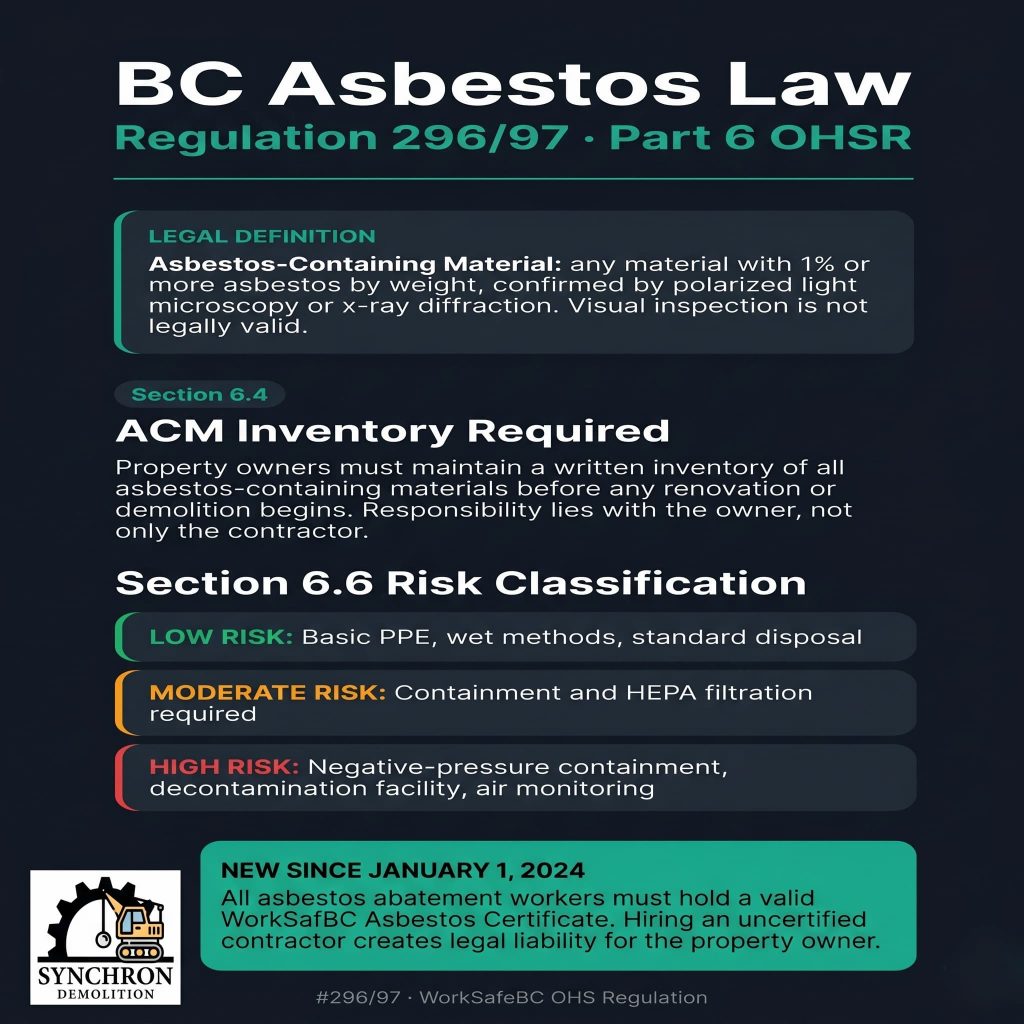
Asbestos testing in British Columbia is governed by Part 6 of BC Regulation 296/97, the Occupational Health and Safety Regulation (OHSR). The key obligations are as follows.
Section 6.4: Asbestos Inventory. The owner of any workplace where workers may be exposed to asbestos must ensure that an inventory of all asbestos-containing materials (ACMs) is prepared and kept current. For renovation projects, this means a written Hazmat report must exist before any trade begins work.
Section 6.6: Assessment and Classification. Before any demolition, alteration, or repair that may disturb ACMs, a qualified person must assess the work and classify it by risk level. The classification determines the controls required.
Risk Level | Typical Scope | Controls Required |
|---|---|---|
Low Risk | Small-scale, non-friable ACMs, limited disturbance | Basic PPE, wet methods, proper disposal |
Moderate Risk | Larger areas, friable material, potential for fiber release | Containment, HEPA filtration, decontamination procedures |
High Risk | Spray-applied fireproofing, large-scale friable removal, full demolition | Full negative-pressure containment, decontamination facility, air monitoring |
Section 6.2.1: Asbestos Certificate Required (effective January 1, 2024). As of 2024, all persons carrying out asbestos abatement in BC must hold a valid WorkSafeBC asbestos certificate. Saeed Toorani, lead abatement supervisor at Synchron Demolition, holds Certificate No. ASB-10006303 (Level 3, valid through May 10, 2027).
Definition of ACM under BC Reg. 296/97: Any material containing 1% or more asbestos by weight, as determined by WCB Method 0205 (dispersion staining, polarized light microscopy) or x-ray diffraction.
Why DIY Asbestos Test Kits Are Not Sufficient
Home improvement stores in Metro Vancouver sell DIY asbestos test kits. Before using one, understand what they do and do not cover.
- Sample collection is uncontrolled. Asbestos fibers are not distributed evenly through a material. A surface swab may miss the asbestos-bearing layer entirely, producing a false-negative result. Certified professionals know where and how deep to sample for each material type.
- DIY kits do not produce a Hazmat report. The certificate you receive cannot be submitted to WorkSafeBC or to any municipal permit office. If your project requires a permit, a DIY kit does not fulfill the regulatory requirement.
- Collecting the sample disturbs the material. If asbestos is present, that disturbance releases fibers without any containment. The $30 to $50 cost of a DIY kit can create a remediation problem costing thousands of dollars to address properly.
- Results take longer. Mail-in DIY kits typically return results in 5 to 10 business days. Professional lab analysis returns results in 2 to 3 business days, with expedited options available.
- Coverage is limited to one material. A DIY kit tests one sample from one material. A certified assessment covers all suspect materials in the property and produces a comprehensive written report.
A professional targeted assessment covering one area of concern starts at $300 and produces results that are legally valid for WorkSafeBC compliance and permit applications.

Asbestos Testing Costs in Metro Vancouver
Asbestos testing costs vary significantly depending on the scope, the number of materials being sampled, the size of the property, and whether a full Hazmat report is required for permit purposes. There is no single price that applies to all projects. The examples below come from real projects we have completed across Metro Vancouver and are meant to illustrate how different scenarios translate into different costs.
- A targeted assessment covering one specific area of concern, such as a single wall, a bathroom, or a section of ceiling, typically involves around six samples and costs approximately $300. This is the right starting point when a project touches one material and no permit is involved.
- A full-property Hazmat survey on a larger home, covering 30 to 40 suspect materials across all rooms, costs between $1,100 and $1,500 depending on the size of the property and the number of materials identified during the inspection walk. This is what most municipal permit applications require.
- Where sampling and the written Hazmat report are scoped separately, sampling alone on a property of around 3,700 square feet typically runs $800 to $1,500, with the full report adding to that cost.
The only way to get an accurate price for your specific project is an on-site assessment. We offer free site visits across Metro Vancouver and provide a written quote before any work begins.
Testing by City
Select your city for location-specific information on asbestos testing requirements, pricing, and project examples:
The Testing Process: Step by Step
Initial call and scope assessment
Same-day or scheduled site visit
Sample collection under safe conditions
Laboratory analysis
Written Hazmat report
We create a step-by-step plan just for your property.
Next steps confirmed
We test the area again to make sure it’s completely safe.
Areas We Serve
We proudly serve these locations:
If you don’t see your area, give us a call. We’ll do our best to help you.