Asbestos cement pipe is pipe made from cement reinforced with asbestos fibres — and removing it in BC is regulated work that must be done by licensed abatement contractors with certified workers. Asbestos cement pipe removal means the controlled excavation, cutting and disposal of buried or exposed lengths of it. Buried and intact, asbestos cement (AC) pipe is low risk: the fibres are locked in the cement and nothing is released. The danger starts when the pipe is cut, snapped, crushed or broken during excavation, because that is what puts fibres into the air.
This guide explains how to identify AC pipe, when it can safely stay in the ground, how licensed removal works step by step, and what BC rules apply to cutting, transport and disposal.
What Is Asbestos Cement Pipe?
Asbestos cement pipe — sold under trade names including Transite — is Portland cement reinforced with chrysotile asbestos fibres instead of steel. The result was a thin-walled pipe that was strong, rot-proof, corrosion-resistant and cheap, which made it the standard choice for buried water, sewer and drainage lines across North America from the 1940s through the 1970s. HealthLinkBC dates AC pipes in Canadian water systems to the 1940s through the 1960s, with use largely discontinued since the 1970s.
AC pipe typically contains about 10–15% asbestos by weight. Its expected service life is roughly 70 years, which means many asbestos cement pipes installed in the 1950s and 1960s are now reaching the end of their design life — one reason it is turning up more often during drainage work, redevelopment and utility upgrades across the Lower Mainland.
In a residential setting, AC pipe is most often found in the lines that carry water away from the house: the storm lateral running out to the street or ditch, buried downspout leader lines, and occasionally a repair section spliced in during the 1970s. The perimeter drain loop beside the footing of a 1950s–1970s home is more often clay tile. So the question is never “is my house asbestos” — it is “what is this specific run made of?”
How to Identify Asbestos Cement Pipe
You cannot be certain a pipe is asbestos cement by looking at it, and nobody honest will tell you otherwise. HealthLinkBC is blunt: “You can’t always tell just by looking whether a material contains asbestos.” But you can narrow it down well enough to know when to stop and test.
| Pipe material | Typical era | What it looks like | Joints | Asbestos concern |
|---|---|---|---|---|
| Vitrified clay tile | Early 1900s–1970s | Red to orange-brown, glazed, hard, short lengths | Bell and spigot | None |
| Asbestos cement (Transite) | 1940s–1970s | Grey to off-white, smooth when new, chalky when weathered, no visible stone | Plain ends with a separate collar or sleeve | Yes — sample and test |
| Concrete | Varies | Grey, visibly coarse with stone aggregate, heavy | Bell and spigot | Usually no — test if unsure |
| Bituminous fibre (“no-corrode”) | 1940s–1970s | Black or dark brown, tar smell, light, deforms into an oval | Tapered push joints | Accounts vary — test |
| PVC or ABS | 1970s onward | White, green or black plastic with printed markings | Solvent weld or gasket | None |
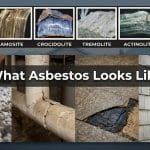
The two most useful tells are the surface and the joint. Asbestos cement is a uniform grey with no stone aggregate showing, and it goes chalky where the ground has weathered it. It is also plain-ended, so lengths connect with a separate collar or sleeve rather than the flared bell you see on clay and concrete. A broken edge shows compressed fibre in a cement matrix instead of sand and gravel.
A drain camera inspection can confirm the material, depth, condition and route of a buried run — but it cannot confirm asbestos content. Only laboratory analysis of a physical sample collected by a qualified person can do that. Treat the camera as the screening step and the lab report as the answer.

Is Buried Asbestos Cement Pipe Dangerous?
Intact and buried, no. The hazard is airborne fibre, full stop. HealthLinkBC’s position is that asbestos “only poses a health risk when it becomes damaged,” and Health Canada notes there are no significant health risks from asbestos materials that are tightly bound in products in good condition — cement piping is one of its own examples.
The same logic applies to drinking water. AC pipe was widely used for potable water mains, but Health Canada and the World Health Organization have concluded there is no consistent, convincing evidence that asbestos ingested through drinking water is harmful, and Health Canada has not established drinking water guidelines for asbestos. Your risk of exposure to airborne asbestos from tap water is very low.
The risk appears when the pipe is disturbed. WorkSafeBC draws the line precisely: under section 6.1 of the Occupational Health and Safety Regulation, work is low risk only while the material is not being “cut, sanded, drilled, broken, ground down or otherwise fragmented.” Do any of those things and the same job becomes moderate risk, bringing controls, respiratory protection and an exposure control plan with it. A bucket clipping an unmarked lateral, a cutoff saw opening a line for a coupling, or a length snapped in half to fit a trailer — every one of those is on WorkSafeBC’s list.
For the science behind why breaking the cement matrix releases fibres, see our explainer on asbestos cement hazards.

When AC Pipe Can Stay in the Ground
There is no rule in BC requiring a homeowner to remove intact asbestos cement pipe from their property. In many cases the safest and cheapest option is to leave it alone. The usual options, in order of how often they are used:
- Leave it and connect to it. If the AC section is the storm lateral and it is sound, a new PVC line can be joined to it with a mechanical coupling on the existing open end. No cutting, no fragmenting.
- Abandon it in place and reroute. A new pipe takes a different line to the discharge point and the old run stays buried and undisturbed. This is often cheaper than removal and it is what the health guidance points toward.
- Have it abated, then dig. Reserved for cases where the AC run is the failed pipe itself and sits directly in the trench line. A licensed abatement contractor removes it, then drainage or construction work proceeds normally.
All three options depend on knowing what is down there first. Identifying the pipe before the machine arrives costs far less than discovering it on day two of an excavation, when work must stop until sampling and an abatement plan are sorted out.
How Licensed Asbestos Cement Pipe Removal Works
When removal is the right call, the work follows a controlled sequence. The details vary by site, but a compliant job in BC generally includes these steps:
- Hazardous materials survey and testing. Before work begins, a qualified person inspects the site and samples suspect pipe. The lab result defines the scope and the risk classification. If you are planning a larger renovation or demolition, this is part of the hazmat report in BC process.
- Notice of project. A notice of project must be submitted to WorkSafeBC for asbestos abatement work before it starts.
- Licensed contractor, certified workers. Since January 1, 2024, employers offering asbestos abatement services in relation to buildings must hold a valid WorkSafeBC licence, and every worker performing abatement must hold certification. WorkSafeBC publishes a searchable public list of licensed contractors — verify any company there before signing a contract.
- Containment and wetting. The work area is controlled and signed. The pipe is kept wet throughout removal — wetting suppresses fibre release and is a standard control for AC pipe work.
- Cutting without dust. AC pipe must be removed in predominantly whole pieces. Approved methods include snap cutters (“squeeze-and-pop” chain cutters), carbide-tipped blade cutters, manual field lathes and hand tools. Sanding, sawing, grinding, chipping and power tools that pulverise the material are not allowed.
- Careful handling. Lengths are lifted out whole, not dropped, thrown or broken to fit a bin. If a length is shattered or badly weathered, it is treated as friable material and handled under stricter controls.
- Double-bagging and labelling. Removed pipe and contaminated soil are sealed in leak-tight containers or double bags of 6 mil (0.15 mm) poly, labelled “asbestos”.
- Licensed disposal. Asbestos waste goes to a facility licensed to accept it. In Metro Vancouver that means the Vancouver Landfill — not a transfer station — and only waste from within Metro Vancouver is accepted. See our guide to hazardous waste disposal in Vancouver for the full requirements.
- Documentation. Disposal manifests and completion records are provided for the project file — documentation that matters for permits, property transactions and strata records.

What Removal Costs
The cost of asbestos cement pipe removal depends on the length and diameter of the run, its depth, how accessible the trench is, whether the pipe is intact or already broken, and the disposal volume. Short, shallow, intact runs are at the lower end of the range; deep, long or fragmented runs with contaminated soil cost considerably more. Because every site is different, a meaningful price can only come from an inspection of the pipe and the trench conditions — contact Synchron Demolition & Abatement for an assessment and a written quote. As an experienced asbestos removal company, Synchron handles testing, licensed removal and compliant disposal in one scope.
What to Do If You Think You Have AC Pipe
If excavation has exposed a grey, fibrous-looking cement pipe — or you are planning drainage work on a pre-1990 property — follow this order:
- Stop work and do not break it further. Do not cut, snap or crush the pipe, and do not sweep up debris dry.
- Keep it damp. Wetting suppresses fibre release while you arrange professional help.
- Photograph it in place. Note the depth, location relative to the house, diameter and joint type. That record shapes the whole scope later.
- Have a sample collected and analysed. A qualified professional collects the sample; an accredited lab confirms whether it contains asbestos.
- Keep the lab report. A negative result frees the excavation immediately. A positive result is the document every other trade on the job will ask for.
AC pipe is often found alongside other asbestos materials in older homes — pipe insulation is a frequent companion, so if your project involves old heating runs, read our guide to asbestos pipe lagging too. For the full removal service, see asbestos removal.
Frequently Asked Questions
Q: Does asbestos cement pipe have to be removed if it is not broken?
A: No. There is no BC rule requiring a homeowner to remove intact asbestos cement pipe. Buried and unbroken, the pipe releases nothing. Removal is usually driven by the pipe having failed, or by construction work that cannot avoid the run — not by the asbestos itself.
Q: Can a homeowner remove asbestos cement pipe themselves?
A: Removing AC pipe is regulated abatement work. In BC, asbestos abatement must be done by a licensed contractor with certified workers, and the waste must be double-bagged, labelled and taken to a licensed facility. A homeowner with a shovel and a reciprocating saw is doing exactly what converts a stable buried material into an airborne one. Hire a licensed firm.
Q: How is asbestos cement pipe cut safely?
A: With methods that keep the pipe in whole pieces and produce no dust: snap cutters, carbide-tipped blade cutters, manual field lathes or hand tools, with the pipe kept wet throughout. Power saws, grinders and abrasive cutting are not allowed because they pulverise the cement and release fibres.
Q: Is drinking water from asbestos cement pipes safe?
A: Health Canada and the World Health Organization have concluded there is no consistent, convincing evidence that asbestos ingested through drinking water is harmful to your health. The health risk from asbestos is inhalation of airborne fibres, not ingestion through water.
Q: Where does asbestos cement pipe waste go in Metro Vancouver?
A: To the Vancouver Landfill, which accepts asbestos waste from within Metro Vancouver only. It is not accepted at transfer stations. Waste must be double-bagged in sealed 6 mil poly bags, labelled “asbestos”, and commercial loads require a hazardous waste manifest and advance notification.
Sources
- WorkSafeBC — Asbestos
- WorkSafeBC — OHS Regulation Part 6: Substance Specific Requirements
- WorkSafeBC — Asbestos licensing and certification: who is required to have a licence or certificate
- Health Canada — Asbestos and your health
- Health Canada — Asbestos in drinking water
- HealthLinkBC — HealthLinkBC File #32: Asbestos
- City of Vancouver — Dispose of residential asbestos waste