The safe time to return after asbestos removal is not based on a fixed number of hours. You should only go back into the area after the work is complete, the space has been carefully cleaned, and a qualified professional has confirmed that it meets the required clearance standards. For some projects, this may happen on the same day. For larger or higher-risk projects, it may take several days.
The Short Answer: Clearance Matters More Than Time
There is no general rule saying that a home is safe exactly 12, 24, or 48 hours after asbestos removal.
The correct time to return depends on whether the work area has passed the required clearance process. The removal team may finish taking out the asbestos-containing material, but this does not always mean the room is ready for people to enter.
Before the area is reopened, it may need:
- Complete removal of asbestos waste
- Detailed cleaning
- A final visual inspection
- Clearance air testing
- Approval from a qualified professional
You should wait until the contractor or asbestos consultant gives you clear permission to return.
Need Asbestos Advice in Greater Vancouver?
If you live in Greater Vancouver or North Vancouver and have questions about asbestos, contact
Synchron Demolition
before starting any renovation or demolition work. Our asbestos specialists can inspect the property,
explain the next steps, and help you arrange professional asbestos testing and safe asbestos removal.
What Happens After Asbestos Removal?
Professional asbestos removal includes more than taking contaminated material out of a building. The work area must also be cleaned and checked before the containment barriers are removed.
Here is what normally happens after the main removal work is finished.
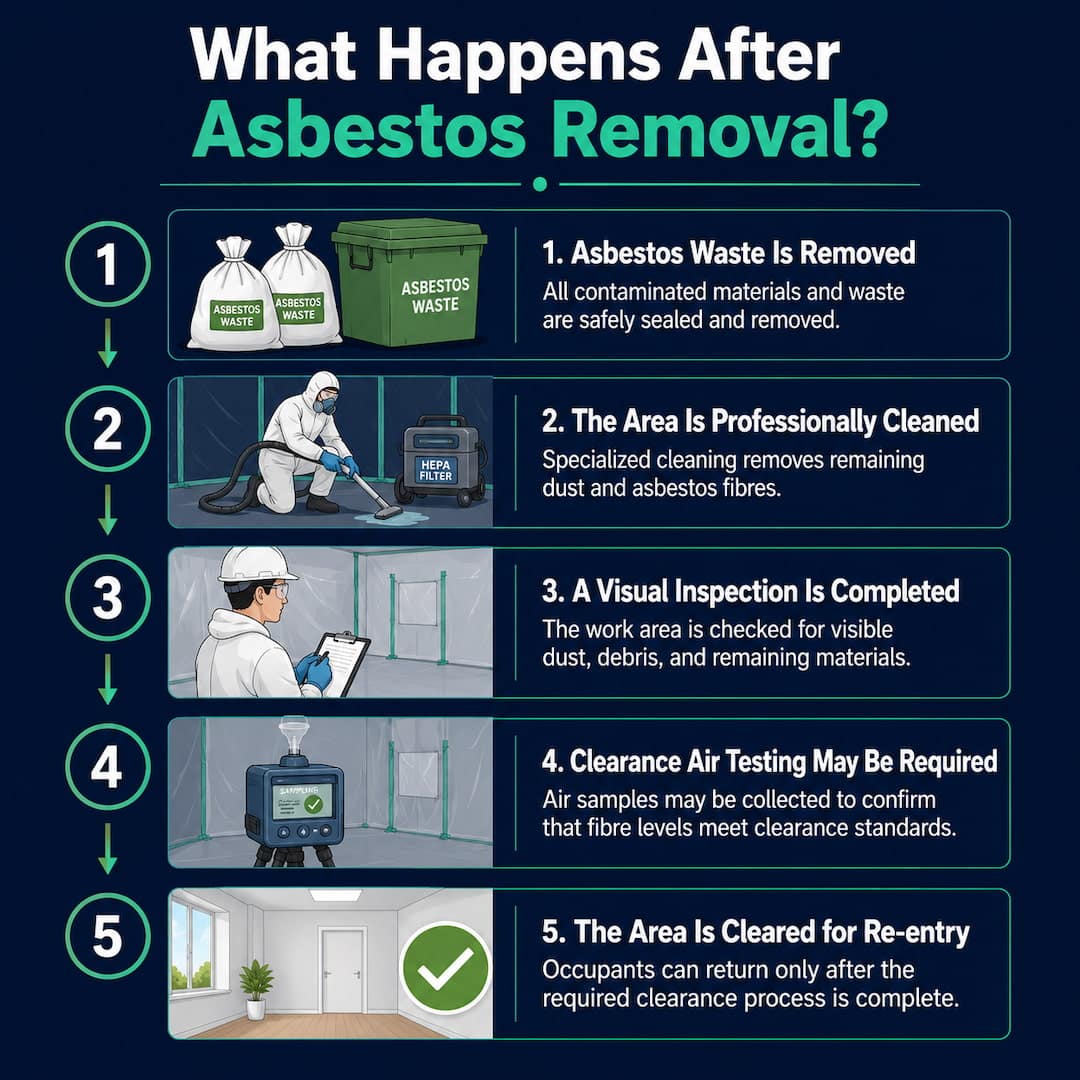
1. All Asbestos Waste Is Removed
The contractor collects the removed material, disposable protective clothing, plastic sheeting, filters, and other contaminated waste.
The waste must be sealed and handled according to the project’s safety plan. Tools and equipment used inside the work area may also need to be cleaned before they are taken outside.
You should not enter the area while contaminated waste is still present.
2. The Work Area Is Carefully Cleaned
After the asbestos-containing material has been removed, the team cleans the work area using methods designed to control very small fibres.
This may include wet cleaning and HEPA-filtered equipment. Regular household vacuum cleaners should not be used because they may release fine fibres back into the air.
Visible dust, small pieces of material, and other debris must be removed before the area can move to the next stage.
3. A Visual Inspection Is Completed
A qualified person should inspect the work area after cleaning.
The inspector checks for:
- Remaining dust or debris
- Pieces of asbestos-containing material
- Damaged surfaces
- Incomplete removal
- Problems with the containment
- Areas that need more cleaning
If anything is found, the removal team must correct the problem before the project can continue.
For high-risk asbestos work in British Columbia, the area must be visually inspected after cleanup and before the containment is taken down.
4. Clearance Air Testing May Be Performed
Clearance air testing checks whether asbestos fibres are still present in the air after cleaning.
During the test, air is collected from inside the work area. The sample is then examined to measure the concentration of airborne fibres.
In British Columbia, high-risk asbestos work requires clearance air sampling inside the previously contaminated containment area. Before the containment can be removed, the airborne asbestos fibre level must not be higher than 0.02 fibres per millilitre.
Not every small or lower-risk asbestos project follows exactly the same testing process. The required steps depend on the type of material, its condition, the work method, and the project’s risk classification.
5. The Area Is Cleared for Re-entry
Once the area passes the required inspection and testing, the qualified person can approve it for re-entry.
The contractor can then remove the containment and allow other renovation work to continue.
For larger projects, workplaces, rental properties, or high-risk removals, ask for written clearance documents. These documents may include the inspection record, laboratory results, and confirmation that the area has met the required standard.
How Long Does the Process Usually Take?
The time needed after asbestos removal can range from a few hours to several days. However, these timeframes are only estimates.
Small Asbestos Removal Projects
A small project may be completed and cleared on the same day when:
- The affected area is limited
- The material is in manageable condition
- The cleanup is straightforward
- No problems are found during the final inspection
- Laboratory testing is not required or results are available quickly
Even for a small project, do not enter the area simply because the workers have left. Ask whether the area has officially been released.
Large or High-Risk Projects
Larger projects often take longer. The clearance process may continue into the following day or take several days when:
- Several rooms are involved
- The material is friable or badly damaged
- A large containment system is used
- Extensive cleaning is required
- Air samples must be sent to a laboratory
- The first inspection or air test does not pass
- More cleaning and another test are needed
The size of the project alone does not decide when it is safe. The final inspection and clearance results are more important than the number of hours that have passed.
Asbestos Testing Before and After Removal
The term asbestos testing can describe two different services.
Testing Before Removal
Before renovation or demolition begins, samples may be collected from materials that could contain asbestos.
These may include:
- Drywall joint compound
- Ceiling texture
- Vinyl floor tiles
- Pipe insulation
- Duct materials
- Cement board
- Vermiculite insulation
- Roofing materials
- Plaster
- Adhesives
You cannot confirm the presence of asbestos just by looking at a material. Suspected materials should be assessed and sampled by a qualified professional instead of being cut, drilled, broken, or removed.
WorkSafeBC advises people not to touch or move suspected asbestos-containing materials. Only qualified professionals should perform asbestos removal.
Testing After Removal
Testing after the project usually means air sampling or clearance testing.
This testing does not check whether a piece of building material contains asbestos. Instead, it checks the air inside the controlled work area after the material has been removed and the space has been cleaned.
Pre-removal material testing and post-removal air testing serve different purposes. Depending on the project, you may need one or both.
What Affects the Re-entry Timeline?
Several factors can affect how soon you can return to the property.
Type of Asbestos-Containing Material
Some materials are more likely to release fibres when they are disturbed.
Soft, damaged, or crumbly materials may require stricter controls than solid materials that remain in good condition. The contractor must review the material and choose the correct work method before removal begins.
Condition of the Material
Damaged material may spread contamination beyond its original location.
For example, broken insulation or damaged ceiling texture can create a more complex cleanup than a small piece of intact material removed under controlled conditions.
Size of the Work Area
Removing asbestos from one small area may take less time than working throughout an entire house, apartment building, commercial property, or industrial site.
Larger work areas require more cleaning, more inspection points, and sometimes more air samples.
Location of the Material
Materials inside walls, ceilings, attics, crawl spaces, mechanical rooms, or ventilation systems may be harder to reach and control.
The contractor may also need to inspect nearby rooms or building systems to make sure contamination has not spread outside the work zone.
Laboratory Turnaround Time
Air and material samples may need to be examined by a laboratory.
The turnaround time depends on the type of analysis, when the samples are collected, and the laboratory’s schedule. Even when the physical removal is complete, the contractor may need to wait for the test results before releasing the area.
Failed Inspection or Air Test
If the area does not pass the visual inspection or clearance air test, it should not be reopened.
The contractor will normally need to:
- Keep the containment in place
- Clean the area again
- Complete another inspection
- Repeat the air testing when required
- Wait for acceptable results
A failed test does not always mean the whole building is contaminated. It means the controlled work area needs more attention before it can be cleared.
How Can You Confirm That the Area Is Safe?
Do not rely only on how the room looks or smells. Asbestos fibres are too small to see with the naked eye, and asbestos does not have a warning smell.
Before returning, ask the contractor these questions:
- Has the removal work been fully completed?
- Has all asbestos waste been removed?
- Did the area pass the final visual inspection?
- Was clearance air testing required?
- What were the air test results?
- Who approved the area for re-entry?
- Can I receive a copy of the clearance report?
- Can the heating or ventilation system be turned on?
- Are there any materials left in place that still contain asbestos?
A professional contractor should be able to explain the clearance process in simple terms.
Check the Contractor’s Licence and Certification
As of January 1, 2024, asbestos abatement contractors that operate as employers in British Columbia must hold the required licence. People performing regulated asbestos abatement work must also complete approved training and receive certification.
Before hiring a company, ask about:
- Its asbestos abatement licence
- Worker certifications
- Insurance coverage
- Experience with similar projects
- The planned containment method
- The type of asbestos testing required
- The person responsible for final clearance
- The documents you will receive after the work
Choosing a qualified contractor helps protect the occupants, workers, neighbours, and future trades working inside the property.
Can You Stay in the Building During Asbestos Removal?
Sometimes occupants can remain in another part of the building, but this depends on the project.
For example, limited work inside a properly controlled area may not require the entire building to be empty. However, larger projects may require everyone to leave until the work is complete.
The decision depends on:
- The project’s risk level
- The location of the material
- The quality of the containment
- Shared hallways and entrances
- Heating and ventilation systems
- The building layout
- Instructions from the asbestos consultant
Do not assume that another room is safe without asking the contractor. Follow the site-specific instructions provided before the work begins.
When Can the HVAC System Be Turned Back On?
Heating, cooling, and ventilation systems may be turned off during asbestos removal to reduce the chance of fibres moving through the building.
Do not restart the HVAC system until the contractor confirms that it is safe.
Before turning it back on, the team may need to check:
- Air supply and return vents
- Duct openings inside the work area
- Filters
- Nearby mechanical equipment
- Seals placed over the vents
- Possible contamination inside the system
Turning the system on too early could move dust from the work area into other parts of the property.
Warning Signs That You Should Not Re-enter
Stay outside the work area and contact the contractor if:
- The containment barriers are still in place
- Warning signs remain at the entrance
- Asbestos waste is still inside
- You can see dust or debris
- The work area has not passed inspection
- Air test results are still pending
- The contractor has not approved re-entry
- The containment appears damaged
- You have not received a clear answer about whether the project is complete
Never enter the containment to check the work yourself.
What Should You Do If You Entered Too Soon?
If you accidentally entered an uncleared work area, stay calm and leave the space without touching or moving anything.
Do not sweep, dust, vacuum, or try to clean the area yourself. These actions could disturb remaining material and spread fibres.
Contact the asbestos removal contractor and explain:
- Where you entered
- How long you were inside
- Whether you touched anything
- Whether the containment was open or damaged
- Whether dust or debris was visible
The contractor or asbestos consultant can decide whether more inspection, cleaning, or asbestos testing is needed.
The health risk from asbestos exposure depends on several factors, including how much asbestos was in the air, how long the exposure lasted, how often exposure occurred, the type of fibres, and the person’s health history. Regular or prolonged exposure to high airborne levels can increase the risk of serious lung diseases.
For personal medical concerns after a possible exposure, speak with a healthcare professional or contact a local health service.
Is a Home Safe If Some Asbestos Remains?
Not every asbestos-containing material must always be removed.
In some cases, material that is in good condition may be left in place and managed safely. It may be enclosed, sealed, or protected from disturbance.
However, everyone planning future work should know where the material is located. Drilling, sanding, cutting, or breaking it later could release fibres.
Ask for a written record showing:
- Where asbestos-containing materials remain
- What condition they are in
- Whether they were enclosed or encapsulated
- What activities should be avoided
- When another inspection may be needed
Never start a new renovation without informing the contractor about known asbestos materials.
Post-removal Safety Checklist
Before going back into the work area, confirm that:
- The asbestos removal scope is complete
- All contaminated waste has been removed
- The work area has been thoroughly cleaned
- The final visual inspection has passed
- Required clearance air testing has passed
- The containment has been removed correctly
- A qualified person has approved re-entry
- You have received the available clearance documents
- You know whether any asbestos remains elsewhere
- The contractor has approved the use of the HVAC system
Final Thoughts
The answer to “how long after asbestos removal is it safe?” depends on successful clearance, not a fixed waiting period.
Do not return simply because several hours have passed or because the room appears clean. Wait until the asbestos waste is removed, the work area is cleaned, the required inspections and tests are complete, and a qualified professional has approved the area for re-entry.
Professional asbestos testing and asbestos removal can protect your property and help prevent avoidable exposure. If you are planning renovation or demolition work in Greater Vancouver or North Vancouver, contact Synchron Demolition for professional asbestos advice and a clear plan for your property.
Frequently Asked Questions
how long do asbestos fibers stay in the air?
Asbestos fibers can remain suspended in the air for many hours, especially in enclosed spaces with limited ventilation. Because the fibers are extremely small and light, they may not settle quickly. The exact time depends on airflow, the size of the fibers, the amount released, and the cleanup methods used.
Do not rely on waiting for the fibers to settle. After asbestos removal, the area should be professionally cleaned, inspected, and tested when required before anyone returns.
how long does asbestos stay on surfaces?
Asbestos fibers can remain on surfaces until they are properly removed. They may settle on floors, walls, furniture, tools, ventilation systems, and other nearby materials.
The fibers do not disappear naturally after a set number of hours or days. Disturbing contaminated dust can release the fibers back into the air. Professional HEPA vacuuming, wet cleaning, inspection, and asbestos testing may be required before the area is cleared.
reinstatement works after asbestos removal?
Reinstatement works are the repairs and rebuilding completed after asbestos removal. They may include replacing drywall, insulation, flooring, ceiling materials, paint, or other building components removed during the abatement process.
Reinstatement should only begin after the asbestos work area has passed the required inspection and clearance process. Contractors should also be informed about any asbestos-containing materials that remain elsewhere in the property.