
If you’re trying to figure out how much it costs to remove asbestos Artex in BC, the short answer is that most homeowners in the Lower Mainland pay somewhere in the range of $800 to $6,000 or more, depending on the size of the job and how the material needs to be handled. A single patch on one ceiling sits at the low end of that range, while a full-house removal that includes asbestos testing, containment, and post-removal clearance sits closer to the high end. These figures are approximate: asbestos pricing depends heavily on what’s actually on your ceiling and walls, so the only way to get a number you can rely on is a site visit from a licensed contractor.
How to Tell Whether Your Artex Contains Asbestos
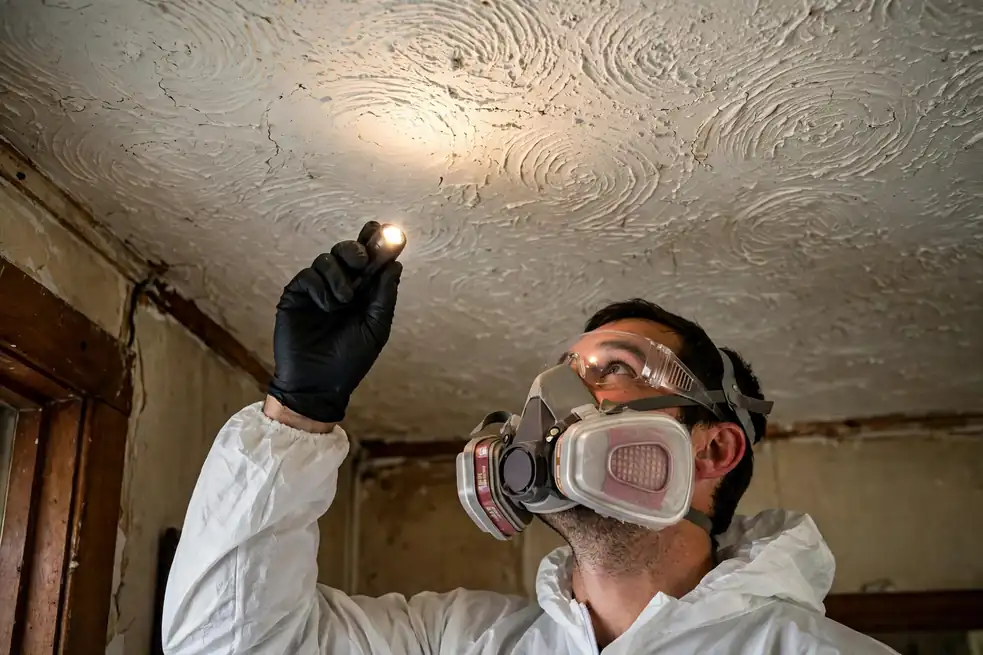
You cannot tell whether Artex contains asbestos just by looking at it. Artex applied before the mid-1980s often contains asbestos, but the coating looks the same whether it does or not. The age of the home is the best clue: textured ceilings in homes built before the mid-1980s are the most likely to contain asbestos, while Artex applied after asbestos was phased out of textured coatings is far less likely to.
The only reliable way to know is professional asbestos testing in BC, where a licensed surveyor takes a small sample of the coating and sends it to a laboratory for analysis. Do not scrape, sand or break off a piece yourself to check, because disturbing the coating can release fibres into the air. The lab result decides whether licensed removal is needed and how much the job will cost, so testing always comes before any quote is final.
What Actually Drives the Price
Several factors move the price up or down before a contractor ever quotes a job. Surface area is the obvious one: more square footage means more labour, more containment, and more disposal volume. Ceiling height and accessibility matter too, since vaulted ceilings or tight stairwells slow down crews and require extra scaffolding or fall protection.
The condition of the Artex itself is often the bigger factor. Intact, undisturbed coating that has never been sanded, drilled, or cracked releases far fewer fibres than material that’s already damaged, flaking, or has been partially removed by a previous owner. Damaged Artex usually requires stricter containment, which adds cost. The number of rooms involved changes the calculation as well, since a contractor working across a whole house can often work more efficiently per square foot than one making a single trip for a small patch. Jobs that require negative air pressure machines and sealed containment, typically the higher-risk or larger-scale removals, carry equipment and setup costs that a simple ceiling patch does not.
Price Ranges by Job Scope
Because scope is the single biggest driver of cost, it helps to think in terms of job size rather than a single number for the whole province.
A small patch repair, covering one section of a single ceiling, tends to fall in the $800 to $1,500 range. A full ceiling in one room is usually somewhere between $1,200 and $2,500, depending on room size and ceiling height. Multiple rooms or an entire floor typically run from $2,500 to $5,000, since contractors can set up containment once and work through several spaces. A whole-house job, particularly in an older North Vancouver or Burnaby property with Artex throughout, often lands between $4,000 and $8,000 or higher.
These bands are approximate starting points, not quotes. Two houses with the same square footage can come in at very different prices depending on ceiling condition and access, which is why an in-person assessment is the only reliable way to price a specific job.
| Job scope | Typical price range | Notes |
|---|---|---|
| Small room (one ceiling) | $800–$1,500 | Testing and containment included |
| Large room or several rooms | $1,500–$3,500 | Price rises with area and access |
| Whole house | $3,500–$6,000+ | Multiple rooms, longer containment |
| Encapsulation instead of removal | $500–$2,000 | Cheaper, but not suitable if damaged |
| Testing (lab sample) | $150–$400 | Needed before any quote is final |
These are typical Lower Mainland ranges, not a quote. The survey result sets the final price.
Encapsulation vs Full Removal
Cost also depends on which method you choose. Encapsulation, sealing the Artex in place with a specialized coating, is generally cheaper upfront than tearing the material out entirely, since it skips the labour-intensive removal and disposal steps. Full removal costs more at the time of the job but eliminates the asbestos from the property altogether, which avoids future disclosure obligations and the cost of re-encapsulating the surface down the line if it’s ever damaged. Neither approach is automatically the right call. The decision usually comes down to whether you’re planning to renovate that surface eventually, how long you intend to own the property, and how much risk tolerance you have for future disturbance.
Why DIY is not an option in BC
Under current BC rules, asbestos abatement work must be done by a licensed contractor, so removing asbestos Artex yourself is not an option. Since January 1, 2024, anyone performing asbestos abatement work in relation to a building must hold the correct certification, and asbestos abatement contractors must hold a valid licence to operate in British Columbia. A homeowner cannot legally do this work themselves.
The risks of an unlicensed attempt are also financial. Asbestos work that isn’t done to WorkSafeBC standards has a real chance of failing post-removal air clearance testing, which means paying a licensed crew to redo the containment and removal from scratch, on top of whatever was already spent. Contamination that spreads beyond the work area, drywall dust tracked through a hallway, fibres released into an HVAC system, can turn a single-room job into a whole-house remediation. There are also fines tied to improper handling and disposal of asbestos-containing material in BC. A licensed contractor’s quote already accounts for proper containment, disposal, and testing, which is usually why it ends up costing less in total than an unlicensed attempt that goes wrong.
What the Removal Day Looks Like, Step by Step
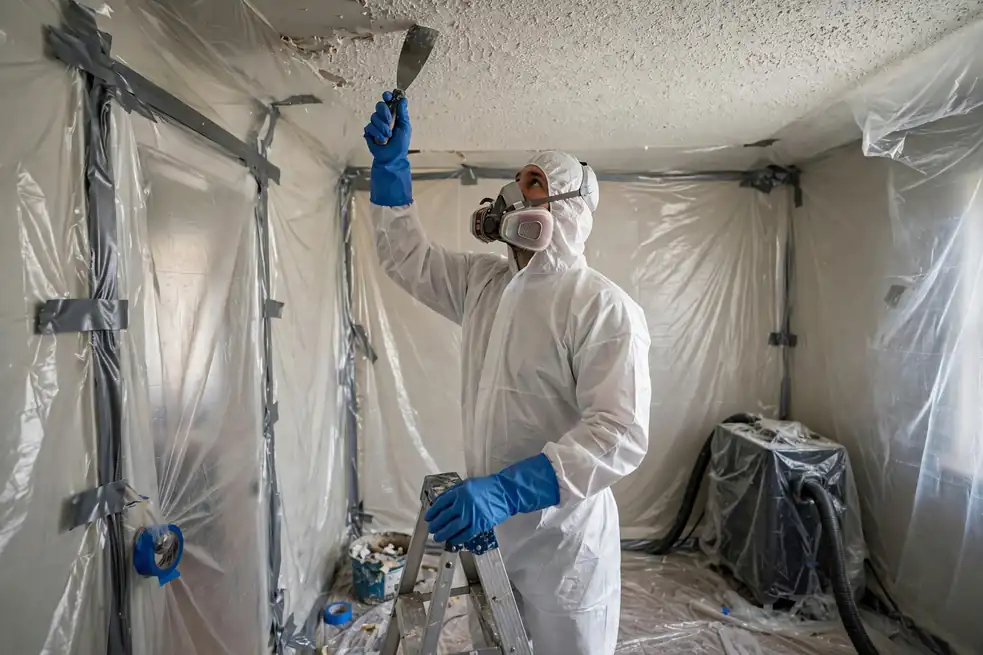
A licensed Artex removal job follows the same sequence on most homes. First, the crew seals off the work area with plastic sheeting and sets up negative air pressure so fibres cannot drift into the rest of the house. Furniture is removed or covered, and vents and doorways are sealed.
Next, the crew wets the Artex to keep fibres down and removes the coating in sections, working methodically across the ceiling. The process is similar to removing asbestos ceiling tiles, with containment, wet removal and careful bagging of the waste. Removed material goes straight into labelled, sealed bags, and the crew cleans every surface in the contained area with HEPA-filtered vacuums and wet wiping.
Finally, the crew runs clearance air testing to confirm the room is safe to re-enter. A single room usually takes one to two days, including containment, removal, cleaning and air testing, while a whole house can take a week or more. You can use the room again only after the clearance test passes.
Costs Buyers Often Forget
A handful of line items sit outside the core removal quote and catch people off guard. Lab testing to confirm whether the Artex actually contains asbestos typically costs in the range of $50 to $150 per sample, and it’s worth doing before assuming the worst or the best. Post-removal air clearance testing, which confirms the space is safe to re-occupy, is usually a separate cost from the removal itself. Disposal fees for hazardous waste are higher than regular construction debris, since asbestos-containing material has to go to a facility licensed to accept it. Larger jobs may also require a permit, depending on the municipality. There are also hidden factors that increase asbestos removal cost, such as difficult access, extra containment and disposal fees. For a wider price comparison, see asbestos removal cost in Vancouver and asbestos removal cost in Burnaby.
Artex in Buying and Selling a Home
Artex does not have to be a deal-breaker when a home changes hands, but it does need to be disclosed. If you are selling a home with textured ceilings, tell buyers what you know about the Artex, including its age and any test results. Most buyers will ask for a hazmat report or a price reduction, and some will want the Artex tested or removed before closing.
If you are buying, ask whether the ceilings have been tested and request the lab results and any removal or clearance records. Undisturbed Artex in good condition can often be left in place or encapsulated, while damaged or friable Artex should be dealt with before you move in. The cost of removing asbestos Artex in BC is worth knowing before you commit, so the price of testing or removal is part of your offer, not a surprise after closing.
Getting an Accurate Quote
None of the ranges above will match your specific situation exactly, and that’s the nature of asbestos pricing. A phone estimate or an online calculator can’t account for the condition of your Artex, the layout of your home, or how it was originally installed. The only way to get a number you can actually budget around is an in-person assessment.
Synchron Demolition & Abatement, a WorkSafeBC-licensed asbestos removal company serving North Vancouver, Vancouver, West Vancouver, and Burnaby, can assess your ceiling or walls on-site and give you a firm price based on what’s actually there, not a guess based on square footage alone.
Frequently Asked Questions
How much does it cost to remove asbestos Artex in BC?
Most Lower Mainland homeowners pay roughly $800–$6,000 or more, depending on the size of the ceiling, how much Artex is present and whether it is friable. Small rooms cost less, while whole-house textured ceilings cost far more. Always get an itemised quote after testing, because the price depends on the survey results.
Is Artex with asbestos dangerous if left alone?
Usually not, as long as it is in good condition and undisturbed. Asbestos in Artex only becomes a risk when the coating is damaged, drilled, scraped or sanded, because that releases fibres into the air. If the ceiling is intact and you are not renovating, encapsulation or simply leaving it alone is often the safest option.
Can asbestos Artex be encapsulated instead of removed?
Yes. Encapsulation means sealing the Artex with a specialist coating or covering it with new plasterboard, so the fibres stay locked in. It is cheaper than removal and avoids disturbing the asbestos, but it is not suitable for damaged ceilings, and you must disclose it when selling the home.
How long does asbestos Artex removal take?
A single room usually takes one to two days, including containment, removal, cleaning and air testing. A whole house can take a week or more. The timeline depends on the size of the area, access, and how long clearance air testing takes before you can use the room again.
Do I need asbestos testing before removing Artex?
Yes. Artex applied before the mid-1980s often contains asbestos, but you cannot tell by looking at it. A licensed surveyor takes a small sample for lab testing first, and the result decides whether licensed removal is needed and how much it will cost.