Asbestos cement pipes were widely used in water and sewer systems. Over time, these pipes deteriorate, releasing hazardous asbestos fibers. If you need to remove asbestos cement pipes, asbestos removal must be handled with extreme care. Safety and legal compliance should be your top priorities. This guide will help you understand the risks, legal requirements, and best practices for safe removal.
What Is Asbestos Cement Pipe?
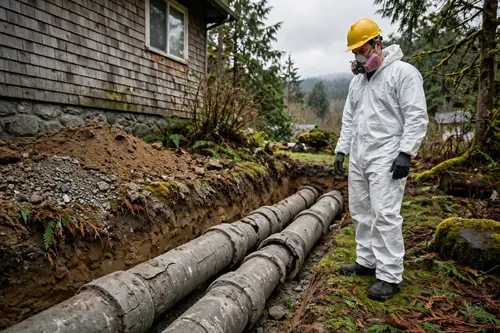
Asbestos cement pipe is a hard, grey pipe made by bonding cement with asbestos fibres. It was widely used from the 1940s to the 1980s for water mains, sewer lines, drainage and flues in homes and municipal systems. While the pipe is intact, the fibres are locked into the cement and the risk is low — the danger appears when the pipe is cut, broken or disturbed during digging, demolition or repair. Our guide to asbestos cement hazards explains how fibres are released when cement products are disturbed.
Understanding the Risks
Asbestos exposure can cause severe health problems, including asbestosis, lung cancer, and mesothelioma. When asbestos cement pipes are cut, broken, or disturbed, they release microscopic fibers that can stay in the air for hours. Inhaling these fibers is dangerous. This is why removing them requires proper procedures and protective measures. Pipes are also often wrapped in asbestos pipe lagging, a separate insulation material that is highly friable and must be assessed at the same time.
Legal & Regulatory Requirements
In Vancouver, asbestos removal is regulated by WorkSafeBC and the Canadian Environmental Protection Act. Key legal requirements include:
- Hiring certified asbestos abatement professionals for removal
- Using approved safety equipment and procedures
- Proper disposal at designated facilities
Failure to follow regulations can result in fines and health risks. Always check local guidelines before starting any removal project.
Since January 1, 2024, asbestos abatement work in BC must be done by a licensed asbestos abatement contractor under WorkSafeBC rules — homeowners may not remove asbestos cement pipe themselves. Cutting or breaking the pipe without a licence can lead to stop-work orders and fines. A licensed asbestos removal contractor handles the notification, safety controls and disposal for you.
Preparation & Site Assessment
Before starting, a thorough site assessment is essential:
- Inspect the area – Identify all asbestos-containing materials.
- Notify authorities – Depending on the project size, permits may be required.
- Set up containment – Use barriers and wet methods to reduce fiber release.
- Wear protective gear – At minimum, use respirators, disposable suits, and gloves.
In BC, any project that disturbs pre-1990 building materials needs a hazardous materials survey first. Before work begins, learn what a hazmat report covers so you know what the survey should include.

How Licensed Professionals Remove Asbestos Cement Pipe
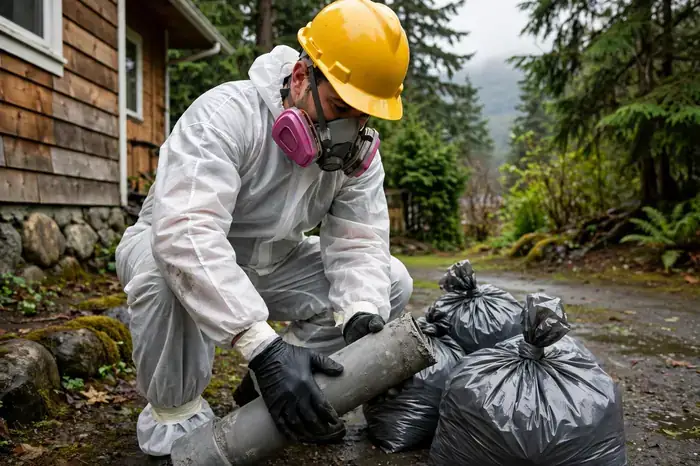
Do not attempt this yourself. In BC, asbestos cement pipe removal is restricted to licensed asbestos abatement contractors, so the stages below describe what a licensed team does — not instructions for a homeowner. Cutting or breaking asbestos cement pipe without training, containment and proper equipment releases fibres and can lead to stop-work orders and fines.
- Assessment and testing – The team starts with a site assessment and a hazardous materials survey, with samples sent to a laboratory to confirm whether the pipe contains asbestos.
- Containment – The work area is sealed off with barriers and signage, and controls are set up to keep fibres from spreading. People and pets stay out of the area.
- Removal – Where possible, whole sections of pipe are removed intact. Where cutting is unavoidable, wet methods keep fibres down, and workers wear respirators and protective suits.
- Disposal – Waste is double-bagged in labelled, leak-tight bags and taken by an authorized carrier to a facility licensed to accept asbestos.
- Clearance – Clearance air testing confirms the area is safe before anyone re-enters or the area is put back into use, and the contractor provides written clearance documentation.
Each stage is documented, so you have a record that the work was done legally and safely.
Asbestos Cement Pipe — What Professionals Do at Each Stage
| Stage | What the licensed team does | Homeowner’s role |
|---|---|---|
| Assessment and testing | Hazmat survey, lab testing | Do not disturb the pipe |
| Containment | Sealed work area, signage | Keep people and pets away |
| Removal | Wet methods, whole-section removal where possible | Stay out of the work area |
| Disposal | Labelled bags, authorized facility | Never use regular bins |
| Clearance | Air monitoring, written clearance | Wait for clearance before re-entry or use |
Proper Disposal
Asbestos waste must be taken to licensed disposal facilities. Make sure to:
- Double-wrap pipes in plastic
- Label them as asbestos-containing material
- Transport them following municipal regulations
Your contractor should give you disposal manifests as proof that the waste was handled legally.
Decontamination & Site Cleanup
Once the pipes are removed:
- Vacuum the area with HEPA filters
- Wipe down surfaces with damp cloths
- Conduct air monitoring to ensure no asbestos remains
No one should re-enter or use the area until clearance air testing confirms it is safe.
What Affects the Cost of Asbestos Cement Pipe Removal
There is no single price for asbestos cement pipe removal, because the cost depends on the job. The main cost factors are:
- Pipe length and diameter – Longer runs and larger-diameter pipes mean more material to remove, contain and dispose of.
- Access – Pipes buried underground, under concrete or in tight crawl spaces take more time and equipment to reach safely than exposed pipes.
- Testing – A hazardous materials survey and laboratory testing are needed before work starts, and the number of samples affects the cost.
- Disposal – Asbestos waste must go to a licensed facility, and disposal fees depend on the weight and volume of the waste.
- Clearance – Post-removal air monitoring and written clearance add to the cost, but they are the proof that the area is safe.
Because every job is different, the only reliable way to know the price is to get a written quote after testing, with each item — survey, containment, removal, disposal and clearance — listed separately. Ask your contractor for an itemised quote before work begins.
Hiring Professionals for Safe Removal
Handling asbestos without proper training is extremely risky and can pose serious health hazards. At Synchron Demolition, we specialize in asbestos testing, removal, and safe disposal. Our fully certified team follows strict safety protocols to protect both you and the environment.
Contact us if you need expert help with asbestos cement pipe removal.
Final Thoughts
Removing asbestos cement pipes requires careful planning, protective measures, and compliance with regulations. Whether you are a homeowner or contractor, safety should be your main concern. If you’re unsure about the process, hiring professionals is the best way to ensure a safe and legal removal.
Frequently Asked Questions About Asbestos Cement Pipe Removal
What is asbestos cement pipe and where was it used?
Asbestos cement pipe is a hard, grey pipe made by bonding cement with asbestos fibres. It was widely used from the 1940s to the 1980s for water mains, sewer lines, drainage and flues in homes and municipal systems. The fibres are locked into the cement while the pipe is intact, which is why the risk mainly appears when the pipe is cut or broken.
Is asbestos cement pipe dangerous if left in the ground?
Generally the risk is low while the pipe is intact and buried, because the fibres are bound in the cement and there is no exposure pathway. The danger arises when the pipe deteriorates, cracks, or is disturbed during digging, demolition or repair. Any work that could break the pipe must start with testing and a plan from a licensed professional.
Can a homeowner remove asbestos cement pipe in BC?
No. Asbestos cement pipe removal in BC must be done by a licensed asbestos abatement contractor under WorkSafeBC rules. Cutting or breaking the pipe yourself releases fibres and can lead to stop-work orders and fines. A licensed team uses wet methods, containment and proper disposal, and provides clearance documentation when the work is finished.
How do professionals remove asbestos cement pipe?
A licensed team starts with a site assessment and testing, then seals off the work area and sets up controls. Where possible, whole sections of pipe are removed intact; where cutting is unavoidable, wet methods keep fibres down. Workers wear respirators and protective suits, waste is double-bagged and labelled, and clearance air testing confirms the area is safe.
How is asbestos cement pipe waste disposed of in BC?
Asbestos waste must be double-bagged in labelled, leak-tight bags, transported by an authorized carrier, and taken to a facility licensed to accept asbestos. It must never go in regular garbage, a standard disposal bin, or a general landfill. Your contractor should give you disposal manifests as proof that the waste was handled legally.
Do I need a permit to replace asbestos cement pipe?
It depends on the job. Plumbing work and demolition may need a municipal permit, and any project that disturbs pre-1990 building materials in BC needs a hazardous materials survey first. Ask your municipality before work starts, and make sure your contractor includes permits and the survey in the written quote.
Sources
- WorkSafeBC — BC rules for asbestos abatement licensing and safe work procedures.
- Health Canada — Asbestos and your health — federal guidance on asbestos in building materials.
- US EPA — Asbestos — asbestos in cement products and hiring a professional.
- CCOHS — Canadian guidance on asbestos cement products and worker protection.
- Government of BC — BC guidance on hazardous waste disposal.