A homeowner in British Columbia should not assume they can remove asbestos without training or approval. Under current WorkSafeBC rules, a person carrying out asbestos abatement work in relation to a building must hold the correct asbestos certificate. When a homeowner hires an asbestos removal company, the contractor must also hold a valid Asbestos Abatement Licence. These requirements have been in effect since January 1, 2024.
The Province of British Columbia also publishes a guide called Managing Waste Asbestos by Homeowners. However, this guide mainly explains how asbestos waste must be identified, stored, transported, and disposed of. It does not give homeowners general permission to carry out asbestos removal without the training, certification, permits, testing, and safety controls that may apply. The guide itself recommends calling an asbestos removal expert.
The Short Answer
In most cases, a homeowner should hire qualified professionals instead of trying to remove asbestos alone.
Current WorkSafeBC guidance says that anyone performing asbestos abatement work in relation to a building must complete mandatory safety training and hold the certificate required for that type of work. A company offering asbestos removal services in BC must hold a valid licence, and homeowners can check the contractor through WorkSafeBC’s licence registry.
Even when the work is taking place in a private home, other responsibilities may still apply. These can include:
- Professional asbestos testing
- Risk assessment
- Local renovation or demolition permits
- Safe waste storage
- Transportation requirements
- Disposal at an authorized facility
- Protection of contractors and other workers
- Written project and clearance records
The exact requirements depend on the property, the type of work, who is completing it, and whether any workers or contractors will enter the site.
What Changed in BC in 2024?
British Columbia introduced stronger asbestos training, certification, and licensing requirements on January 1, 2024.
Under the current system:
- People performing asbestos abatement work in relation to buildings must have the correct training and certification.
- Asbestos abatement contractors must hold a valid licence to operate in British Columbia.
- Property owners must check that the contractor has a valid licence before allowing the company to start asbestos abatement work at a workplace.
- Contractor licences must be renewed, and WorkSafeBC maintains a public registry showing current licence status.
This is important because some older online articles still suggest that homeowners can freely remove asbestos from their own homes. Those articles may not reflect the current BC certification system.
The provincial homeowner waste guide is dated March 2020. It is still available through the Province’s asbestos waste page, which was updated in December 2024, but it should be read together with the newer WorkSafeBC licensing and certification rules.
What Does the BC Homeowner Asbestos Guide Cover?
The provincial guide focuses on waste asbestos after asbestos-containing materials have been disturbed or removed.
For the purpose of that guide, a homeowner is generally an owner who lives in, or intends to live in, a detached home as a permanent residence. It can also include an owner-occupier of a strata dwelling. Companies that buy, renovate, rent, or sell houses as part of their business do not fall under the guide’s homeowner category.
The guide explains that homeowners who generate hazardous waste asbestos may be responsible for:
- Having the material properly sampled and characterized
- Registering as a hazardous waste generator when quantity limits are reached
- Keeping the waste safely contained
- Meeting transport and manifest requirements where applicable
- Using an authorized receiving or disposal facility
These requirements show why asbestos removal is not the same as ordinary home cleanup. The physical removal is only one part of the job. The waste must also be identified, documented, transported, and accepted by the correct facility.
Do Not Confuse Asbestos Removal Rules With Waste Rules
There are different legal definitions for asbestos-containing materials and hazardous asbestos waste.
Under WorkSafeBC guidance, a manufactured building material is generally treated as asbestos-containing when testing finds at least 0.5 percent asbestos. Vermiculite insulation is treated differently and may be considered asbestos-containing when any asbestos is detected through the required testing method.
The BC Hazardous Waste Regulation uses a different test for whether removed waste is classified as hazardous waste asbestos. The provincial homeowner guide explains that waste is considered hazardous when it contains more than 1 percent asbestos by weight and is friable, dusty, powdered, or no longer securely bound within the material.
This does not mean material below the hazardous waste threshold is safe to cut, drill, sand, break, or remove. One threshold relates to workplace asbestos identification. The other relates to waste classification and disposal.
A professional can explain which rules apply to the material in your home.
Why Asbestos Testing Must Come First
You cannot confirm whether a building material contains asbestos by looking at it.
WorkSafeBC tells homeowners to have their property tested before renovation or demolition work begins. Suspected materials should be sampled by a qualified person and analyzed using an accepted laboratory method.
Materials that may require asbestos testing include:
- Drywall joint compound
- Textured ceilings
- Ceiling tiles
- Vinyl flooring and flooring adhesive
- Pipe and boiler insulation
- Vermiculite attic insulation
- Cement board
- Older roofing and siding materials
- Plaster and patching compounds
Asbestos has been used in thousands of household products, and it is especially important to consider testing before work in an older home.
Do not collect samples by cutting or breaking the material yourself. A small sample may seem harmless, but disturbing the material can release fibres into the room.
Does Asbestos Always Need to Be Removed?
No. Finding asbestos in a home does not always mean the material must be removed immediately.
Asbestos generally presents less risk when it is in good condition, securely contained, and left undisturbed. The risk increases when the material is damaged, crumbling, drilled, sanded, cut, removed, or affected by renovation work.
Depending on the situation, a qualified professional may recommend:
- Leaving the material in place
- Monitoring its condition
- Enclosing it
- Encapsulating it
- Removing it before renovation or demolition
The right option depends on the material, its condition, its location, and the chance that it will be disturbed in the future.
For example, asbestos-containing flooring hidden under a new finished floor may not need immediate removal if it remains secure and will not be disturbed. Damaged pipe insulation in a mechanical room may require a very different response.
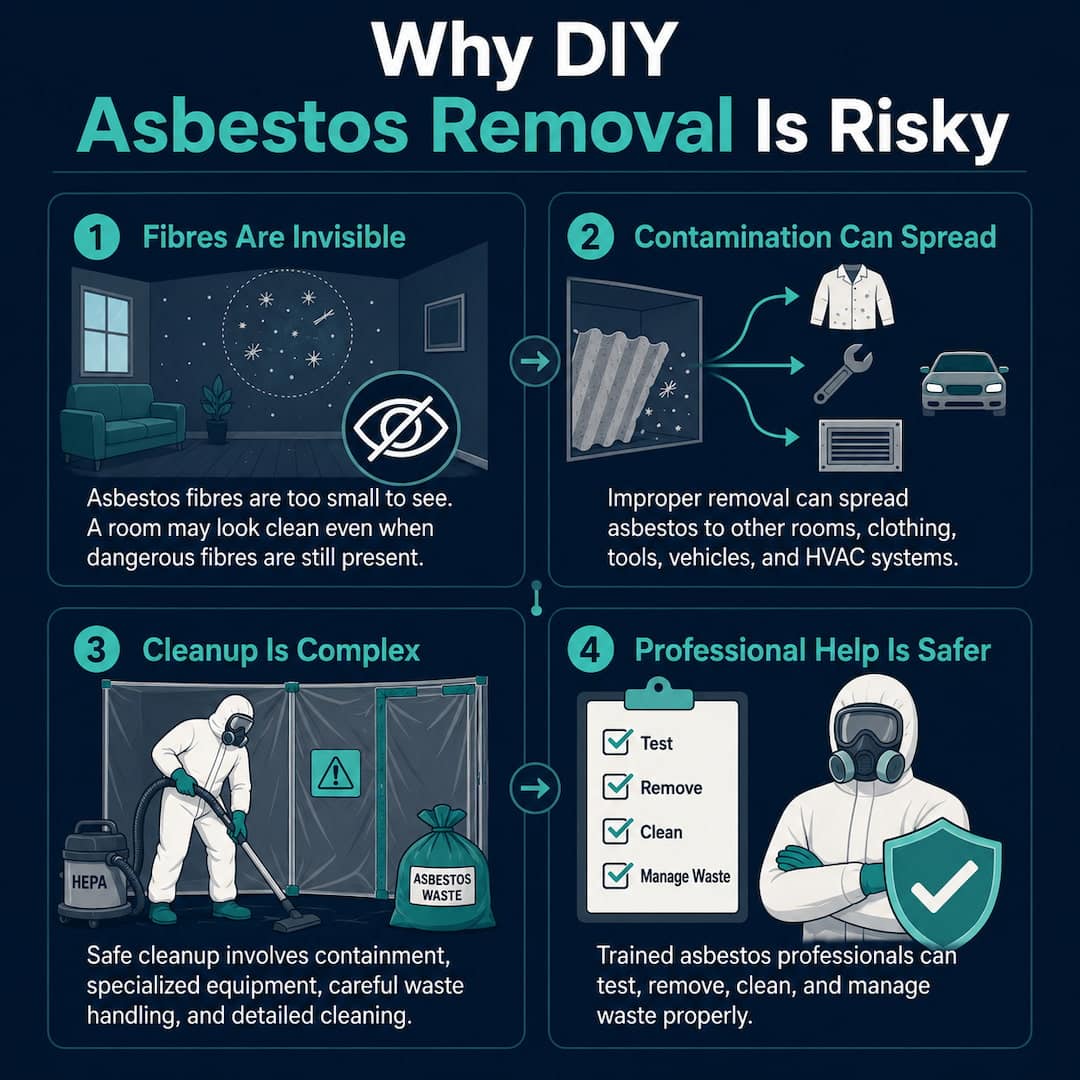
Why DIY Asbestos Removal Is Risky
Asbestos fibres are extremely small. A room may look clean while fibres remain in the air or on surfaces.
When asbestos-containing materials are disturbed, fibres can move beyond the immediate work area. They may reach:
- Nearby rooms
- Hallways
- Clothing
- Tools
- Vehicles
- Furniture
- Heating and ventilation systems
The BC Centre for Disease Control warns that homeowners may face significant exposure even when they try to take precautions. It also states that an N95 mask alone is not enough protection for asbestos removal.
Poor cleanup can create a longer-lasting problem. Dust left on floors, framing, ledges, tools, or ventilation components can be disturbed again during later renovation work.
Professional asbestos removal is designed to manage the whole process, not just the visible material. Depending on the project, this can include containment, controlled work procedures, specialized equipment, decontamination, waste documentation, detailed cleaning, inspection, and clearance testing.
What Happens If Asbestos Is Removed Incorrectly?
Incorrect removal can turn a limited issue into a larger contamination project.
Possible problems include:
- Asbestos fibres spreading into clean areas
- Other contractors being exposed
- Renovation work being stopped
- Additional testing and cleanup costs
- Waste being rejected by a disposal facility
- Permit delays
- Missing documentation when selling the property
- Regulatory action where legal requirements were not followed
The Province states that homeowners are responsible for making sure asbestos waste is properly characterized and sent to an authorized facility. Local governments may also have additional bylaws, renovation rules, or permit requirements.
A receiving facility can refuse asbestos waste when it has not been properly prepared, documented, or arranged in advance.
Asbestos Waste Cannot Go Into Regular Garbage
Asbestos-containing waste must not be placed in ordinary household garbage, mixed construction waste, or an unauthorized bin.
The BC government requires hazardous waste asbestos to be sent to an approved facility that is authorized to receive it. The homeowner is responsible for confirming that the facility, including any transfer or temporary storage location, has the correct authorization.
Transport rules can also apply. The homeowner guide explains that transporting more than 5 kilograms of hazardous waste asbestos may require a manifest, a licensed transporter, or both, unless a specific exemption applies. Homeowners generating or storing more than 1,000 kilograms may also need a BC Generator Number.
These are another reason not to start removing material before you know where the waste can legally go.
Do Homeowners Need a Permit?
A local permit may be required for demolition or major renovation work.
WorkSafeBC’s homeowner information advises that demolition and significant renovations require permits from the local government. Permit rules can vary between Vancouver, North Vancouver, Burnaby, West Vancouver, and other municipalities.
Before work begins, ask your municipality about:
- Building permits
- Demolition permits
- Waste management plans
- Pre-demolition hazardous material reports
- Approved disposal requirements
- Inspection requirements
A building permit does not replace asbestos testing or asbestos abatement requirements. Both parts of the project may need to be handled separately.
What If You Hire a General Contractor?
Hiring a general contractor does not remove the homeowner’s responsibility to ask about asbestos.
Before renovation or demolition begins, confirm who will:
- Arrange asbestos testing
- Review the laboratory report
- Complete the risk assessment
- Hire the asbestos abatement contractor
- Check the contractor’s licence
- Manage the waste
- Provide the final documentation
WorkSafeBC advises homeowners to get their homes tested before renovation or demolition and to hire qualified contractors for testing and safe removal.
Do not accept a verbal statement such as “there probably is no asbestos” as a replacement for proper testing.
Use Professional Asbestos Services
The safest approach is to speak with an experienced asbestos company before opening walls, removing flooring, scraping ceilings, or starting demolition.
For homeowners in Greater Vancouver, Vancouver, Burnaby, North Vancouver, and West Vancouver, Synchron Demolition can help you understand the next steps. Our team can assist with asbestos testing coordination, project assessment, asbestos removal planning, demolition preparation, and safe waste management.
Professional support is especially important when:
- The material is damaged or crumbling
- Several rooms are involved
- Vermiculite insulation is present
- The work affects ceilings, walls, flooring, or mechanical systems
- The property has tenants
- Contractors will be working in the building
- A renovation or demolition permit is required
- The type or amount of asbestos is unknown
Contact Synchron Demolition before disturbing suspected materials. Early testing and planning can prevent delays, unexpected costs, and contamination during renovation.
How to Choose an Asbestos Removal Contractor in BC
Before hiring a contractor, check more than the quoted price.
Verify the Licence
WorkSafeBC provides an Asbestos Abatement Licence Registry. Confirm that the company’s licence is current and has not expired, been suspended, or been cancelled. WorkSafeBC notes that licences are valid for one year and must be renewed.
Ask About Worker Certification
Ask whether the people completing the work hold the certificates required for the risk level and type of asbestos abatement being performed.
Ask for a Clear Scope
The written quote should explain:
- What materials will be removed
- Which rooms are included
- Whether testing is included
- How other areas will be protected
- Who is responsible for waste
- Whether clearance testing is required
- What records you will receive
Check Insurance and WorkSafeBC Status
WorkSafeBC recommends obtaining an up-to-date clearance letter and checking the contractor’s licence details before work starts.
Confirm the Disposal Plan
Ask where the waste will be taken and whether the receiving facility is authorized to accept asbestos waste. The contractor should be able to explain how the waste will be tracked and documented where required.
What Should You Do Before Renovating an Older Home?
Use this simple order:
- Stop before disturbing suspicious materials.
Do not drill, cut, scrape, sand, or remove them. - Arrange professional asbestos testing.
Testing confirms which materials contain asbestos. - Review the project scope.
Decide which materials will be affected by the renovation. - Get professional advice.
A qualified person can determine the risk level and proper response. - Check permits and contractor credentials.
Confirm municipal requirements and verify the asbestos contractor’s licence. - Complete asbestos removal before general demolition.
Other workers should not disturb asbestos-containing materials. - Keep the reports.
Save laboratory results, removal records, waste documents, and clearance information for future renovations or property sales.
Frequently Asked Questions
Can a homeowner remove asbestos in BC?
Current WorkSafeBC guidance says that a person performing asbestos abatement work in relation to a building must hold the correct asbestos certificate. A contractor hired to complete the work must also hold a valid Asbestos Abatement Licence. Because waste, transport, permits, testing, and local rules may also apply, homeowners should use qualified professionals.
Is DIY asbestos removal legal in BC?
It should not be treated as ordinary DIY work. Current certification rules, worker safety rules, hazardous waste regulations, and local permit requirements may apply. The provincial homeowner waste guide does not remove these responsibilities or provide general permission for untrained removal.
Do I need asbestos testing before renovation?
WorkSafeBC advises homeowners to have their home tested before renovation or demolition work begins. Testing is especially important when older walls, ceilings, floors, insulation, roofing, siding, or mechanical materials will be disturbed.
Can I put asbestos waste in a regular disposal bin?
No. Hazardous waste asbestos must be sent to an authorized facility, and transport or documentation requirements may apply. Confirm the disposal plan before removal begins.
Can I stay in the home during asbestos removal?
It depends on the location, amount, condition, risk level, and containment plan. The contractor or qualified consultant should provide clear instructions before work begins. For some projects, occupants may need to leave the work area or the entire property until the required clearance process is complete.
Can asbestos be left inside a home?
Yes, in some cases. Asbestos-containing material that is in good condition and will not be disturbed may be managed in place. A qualified professional should assess the material and explain whether monitoring, enclosure, encapsulation, or removal is appropriate.
Do I need a licensed asbestos contractor in BC?
Asbestos abatement contractors must hold a valid licence to operate in British Columbia. Homeowners can check the company’s status through WorkSafeBC’s public licence registry.