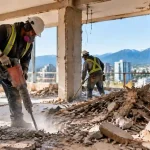
If you have started pricing a teardown, you have probably noticed that every source gives you a different answer. One site says four dollars per square foot, another says twenty five, and none of them explain why. That gap is not sloppiness. It is the difference between a simple post-war bungalow on a wide lot and a 1920s character home that the City will not let you touch until a licensed abatement crew has been through it. So how much does it cost to demolish a house in Vancouver? The honest answer is that the base teardown is the cheap part, and the paperwork and hazardous materials around it are what decide your final number.
This guide breaks the cost into the line items that actually appear on a real quote. We have pulled it together from the work we do every week as a WorkSafeBC licensed contractor providing demolition services in Vancouver, so the emphasis is on the parts homeowners are usually surprised by rather than the parts that are easy to look up. By the end you will know what to budget, what the City will hold on deposit, and which single line item is most likely to move your total by five figures.
The short answer on Vancouver house demolition cost
A full residential demolition in Vancouver typically runs between $20,000 and $45,000 for a standard 2,000 square foot detached home, before hazardous material removal. The range is wide because site access, foundation type, and the age of the house all pull the number in different directions. The table below gives a realistic starting point by size.
| Structure | Typical range* | What usually drives the variance |
|---|---|---|
| 1,000 sq ft house | $12,000 to $22,000* | Crawl space versus full basement |
| 1,500 sq ft house | $16,000 to $32,000* | Lot width and equipment access |
| 2,000 sq ft house | $20,000 to $45,000* | Foundation removal and disposal volume |
| 3,000 sq ft house | $30,000 to $65,000* | Multiple storeys, concrete and masonry |
| Detached garage | $2,000 to $5,000* | Wood frame versus concrete slab |
| Interior strip out only | $4 to $9 per sq ft* | Whether the structure stays occupied nearby |
Treat these as the cost of the physical work only. Permits, deposits, utility disconnections, and abatement sit on top, and we cover each of those below.
What is actually included in a demolition quote
Most people picture an excavator and a dump truck. In practice, the machine time is a minority of the invoice, and a quote that only covers the teardown itself is a quote you will end up topping up later. A complete residential demolition scope normally includes the following.
- Site preparation, including hoarding, fencing, and protection of neighbouring property and the city boulevard
- Coordination of utility disconnections for gas, electrical, water, and sewer, each of which is booked with the provider and has its own lead time
- The structural demolition itself, including interior finishes, framing, and roofing
- Foundation and slab removal, which is often quoted separately and is a common source of scope disputes
- Loading, hauling, and tipping fees at a Metro Vancouver transfer station, with separated loads for wood, drywall, concrete, and metals
- Final site grading and cleanup so the lot is ready for the next trade
If a written quote does not name each of these, ask which ones are excluded before you compare it against anyone else’s number.
Demolition cost per square foot and what moves the number
Most contractors in the Lower Mainland price residential demolition on a per square foot basis, then adjust for site conditions. The published range across Metro Vancouver sits roughly between $9 and $25 per square foot, and where you land inside that range is decided almost entirely by access and complexity rather than by the size of the house.
These are the factors that move a quote the most, in rough order of impact.
- Site access. A 33 foot lot in Mount Pleasant or Grandview-Woodland with parked cars on both sides and no lane access can add a quarter to the labour cost, because material has to be moved in smaller loads. Wider lots in Dunbar, Kerrisdale, or Point Grey are usually cheaper to work on.
- Foundation and basement. A full concrete basement means breaking, loading, and disposing of a large volume of heavy material. A crawl space or slab on grade is significantly less.
- Proximity to neighbours. Tight setbacks in East Vancouver often require hand demolition of the sections nearest the property line instead of machine work.
- Trees and landscaping. Protected trees change how equipment can be positioned and sometimes require an arborist on site.
- Construction materials. Concrete, brick chimneys, and masonry cost more per square foot to break down and dispose of than wood frame.
None of these are unusual. They are simply the reason a phone estimate given without a site visit is worth very little.
Permit fees and the green demolition deposit
You cannot demolish a house in Vancouver without a demolition permit, and the conditions attached to that permit depend on the year the house was built. This is the part of the budget that catches people out, because the City holds a substantial refundable deposit that is not a fee but does tie up cash for the length of the project. The requirements break down as follows.
| Year built | Reuse and recycling requirement | Deconstruction required | Refundable deposit |
|---|---|---|---|
| 1950 or later | No mandated diversion rate, but drywall is banned from landfill and must be recycled | No | None* |
| Before 1950 | Minimum 75 percent of materials by weight, excluding hazardous materials | No | $15,310* |
| Before 1950, character house | Minimum 90 percent by weight, excluding hazardous materials | No | $15,310* |
| Before 1910, or heritage listed and pre-1950 | Minimum diversion plus wood salvage | Yes, minimum 3 tonnes of wood salvaged | $15,310* |
Two things matter here. First, the deposit is returned only if the reuse and recycling compliance report is accepted, which means your contractor has to keep every weigh ticket from day one. Second, since September 2025 the City requires salvage and abatement work to be carried out within the scope of the demolition permit itself, so you can no longer run abatement as a completely separate job on a separate schedule. If you want the full permit picture, we cover it in detail in our guide to demolition permit requirements in Vancouver. Confirm the current fee schedule directly with the City before you finalise a budget, because it is updated annually.
The line item that changes everything: hazardous materials
If your house was built in 1990 or earlier, a qualified professional must complete a hazardous building material report and it must be uploaded to your permit account before the final inspection. This is not optional and it is not a formality. It is the single item most likely to move your total, and it is also the reason two identical looking houses on the same block can be quoted $15,000 apart.
The report tells you what is present. What you do about it is where the money goes. Older Vancouver homes routinely contain asbestos in vinyl and linoleum flooring, textured ceilings, pipe insulation, drywall joint compound, attic vermiculite, and exterior stucco. Our explainer on what a hazmat report covers walks through how the survey itself is carried out. If you have not had one done yet, asbestos testing in Vancouver is the first step, and it should happen before you collect demolition quotes rather than after.
| Item | Typical range* | When it applies |
|---|---|---|
| Hazardous building material survey | $500 to $1,500* | Any structure built in 1990 or earlier |
| Additional lab analysis per sample | $50 to $100* | Where multiple material types are suspected |
| Textured or popcorn ceiling removal | $3 to $7 per sq ft* | Common in homes built 1950 to 1980 |
| Vermiculite attic insulation removal | $7,000 to $10,000* | Typical mid-size attic, priced by area |
| Pipe and duct insulation removal | $500 to $2,500* | Older boiler and heating systems |
| Full house abatement | $10,000 to $30,000 and up* | Widespread contamination across materials |
There is a practical reason to keep abatement and demolition under one contractor. When two companies handle them separately, the demolition crew waits on the abatement crew, clearance testing gets scheduled twice, and the site sits idle in between. Because we hold the WorkSafeBC licence for both, our asbestos removal and demolition work run on a single schedule under a single permit scope, and hazardous waste disposal is documented the same way the City wants it documented for your deposit refund.
Demolition or deconstruction: which one your house qualifies for
These two words are often used interchangeably, but in Vancouver they describe different legal obligations with different price tags. Mechanical demolition takes the structure down quickly with equipment. Deconstruction takes it apart by hand so that timber and fixtures can be salvaged and reused, which takes longer and costs more but recovers material with real resale value.
| Mechanical demolition | Deconstruction | |
|---|---|---|
| Typical duration | 2 to 5 days on site* | 2 to 4 weeks on site* |
| Relative cost | Lower | Higher, partially offset by salvage value |
| Diversion achieved | Meets 75 percent with sorting | Highest, supports 90 percent and wood salvage |
| Who it applies to | Most homes built 1950 or later | Pre-1910 and heritage listed pre-1950 homes |
If your house falls into the pre-1910 or heritage listed category, this is not a choice you get to make on cost grounds. Our deconstruction page explains how the salvage requirement is met and documented.
A worked example: 2,000 sq ft home in East Vancouver
Numbers in isolation are hard to use, so here is how a real budget comes together. The property is a 1972 Vancouver Special in Renfrew-Collingwood, roughly 2,000 square feet over two levels, on a standard 33 foot lot with lane access. Because it was built after 1950 there is no mandated diversion rate and no green demolition deposit, but the stucco exterior and the original sheet flooring both tested positive for asbestos.
| Line item | Cost* | Notes |
|---|---|---|
| Structural demolition and foundation removal | $24,000* | Lane access kept equipment costs down |
| Utility disconnections | $1,500* | Booked with each provider in advance |
| Hazardous building material survey | $900* | Required, house predates 1990 |
| Asbestos abatement, flooring and stucco | $6,500* | Completed under the demolition permit scope |
| Disposal and tipping fees | Included above | Separated loads, weigh tickets retained |
| Demolition permit fee | Confirm with City* | Fee schedule updated annually |
| Green demolition deposit | $0 | Not applicable, built after 1950 |
The total lands near $33,000 plus the permit fee. Notice that the house being newer than 1950 saved the owner the deposit and the diversion paperwork, but did nothing to protect them from the asbestos line. Year of construction tells you about your permit obligations. It does not tell you whether your house contains hazardous material.
Where homeowners lose money on a demolition
Almost every budget overrun we see traces back to one of a small number of avoidable decisions. These are the ones worth guarding against.
- Collecting demolition quotes before testing for hazardous materials. Every quote you receive will exclude abatement, so none of them are comparable and all of them will be revised upward later.
- Hiring separate abatement and demolition contractors. You pay twice for mobilisation and lose days to scheduling gaps between the two crews.
- Losing the green demolition deposit through incomplete documentation. Weigh tickets and disposal receipts have to be collected throughout the job, not reconstructed at the end.
- Starting work before utility disconnections are confirmed in writing. Providers work on their own timelines and a delayed disconnection stalls the entire site.
- Accepting a verbal or single line quote. Without a written scope naming foundation removal, disposal, and site restoration, you have no basis to dispute an extra later.
How to get an accurate demolition quote
The more of the following you can supply up front, the closer a first quote will be to the final invoice, and the less likely you are to be comparing quotes that cover different scopes.
- The year the house was built, and whether it is listed on the heritage register or sits in a character home zone
- Approximate square footage across all levels, and whether there is a full basement, crawl space, or slab
- A copy of the hazardous building material report if one has already been completed
- The exact address, so access, lane availability, and neighbouring setbacks can be assessed
- Whether the demolition is tied to a building permit for a new house or laneway house, since the applications are often submitted together
Getting a number you can budget against
The most useful thing you can do before spending money is find out what is in the building. Once the hazardous material picture is clear, everything else about a demolition budget becomes predictable. We have been carrying out abatement and demolition across the North Shore and Metro Vancouver for over eleven years under a single WorkSafeBC employer licence, which means one crew, one schedule, and one set of compliance records. If you would like a written quote with every line item named, get in touch for a free assessment.
Frequently asked questions
These are the questions we are asked most often when homeowners call about a teardown budget.
Do I need a permit to demolish my own house in Vancouver?
Yes. A demolition permit is required for any residential structure, including one you own outright, and the conditions attached depend on the year the house was built. Work started without a permit can be halted and can carry penalties.
How long does a house demolition take in Vancouver?
The physical demolition of a standard detached home usually takes two to five days on site. The overall timeline from application to a cleared lot is longer, commonly six to ten weeks, because permit processing, utility disconnections, and any required abatement all sit ahead of the machine work.
Is asbestos testing required before demolition in BC?
Yes. WorkSafeBC requires a qualified person to inspect for hazardous materials before demolition or renovation work begins on any building that may contain them, and in Vancouver the resulting report must be uploaded to your permit account for structures built in 1990 or earlier.
Can I get the green demolition deposit back?
The deposit is fully refundable if the reuse and recycling requirements are met and the compliance report is accepted by the City. If the requirements are not met, some or all of it is retained. Keeping complete weigh tickets and disposal records throughout the job is what protects it.
Does the demolition price include removing the foundation?
Not always, and this is one of the most common gaps between two quotes that look similar. Foundation and slab removal adds meaningful cost because of the weight and disposal volume involved, so confirm in writing whether it is inside the scope.
Related Topic:
- How Much Does It Cost to Remove Asbestos Artex in BC?
- Asbestos Removal Cost in Vancouver: 2026 Price Guide
- 10 Hidden Factors That Can Increase the Cost of Asbestos Removal in BC Homes
- Asbestos Removal Cost in Burnaby
- Does Demolition Require Planning Permission in Vancouver?
- Does Vermiculite Contain Asbestos? What You Need to Know